
China Geotextile Fabric for Durable Ground Reinforcement Solutions
2026-08-30
Most ground failures don’t announce themselves—they creep in through weak layers, poor drainage, and repeated load stress. That’s exactly why China geotextile fabric has become a go-to for durable ground reinforcement solutions across demanding projects. At Jinseed Geosynthetics Solution, we’ve supplied fabrics that hold up where ordinary materials break down, helping contractors build with confidence. In this post, we’ll unpack what sets these geotextiles apart and how to match them to your site conditions.
The Hidden Layer That Keeps Heavy Loads from Sinking
Most people only see the surface—pavement, flooring, a slab of concrete—but the real work happens in the layer nobody notices. When a heavy load presses down, it wants to push through whatever sits underneath. Without a carefully built transition zone, that pressure concentrates into a small area and the ground gives way, leaving ruts, cracks, or worse. The hidden layer acts like a quiet mediator. It spreads the load sideways, slows down water movement, and locks the upper surface to the stable ground below.
This layer isn't just an afterthought of crushed rock or sand. It's often a blend of graded aggregate, geotextile fabric, and sometimes chemically stabilized soil. Each ingredient has a specific role: larger stones create a skeleton, sand fills the gaps, and the fabric separates fine particles from coarse ones so they don't mix over time. By keeping the layers distinct, the hidden layer maintains its drainage and load-spreading ability far longer than a simple pile of fill ever could.
What's surprising is how much difference a few inches of well-chosen material can make. A warehouse floor holding stacked pallets, a bridge approach supporting daily traffic, or a crane pad on soft clay—all rely on this unglamorous buffer. When it's done right, you never think about it. When it's missing or poorly compacted, the signs appear quickly: settlement, tilting, and expensive repairs. It's a reminder that the most important part of a structure is often the part you'll never see.
Why Thicker Is Not Always Stronger in Geotextiles
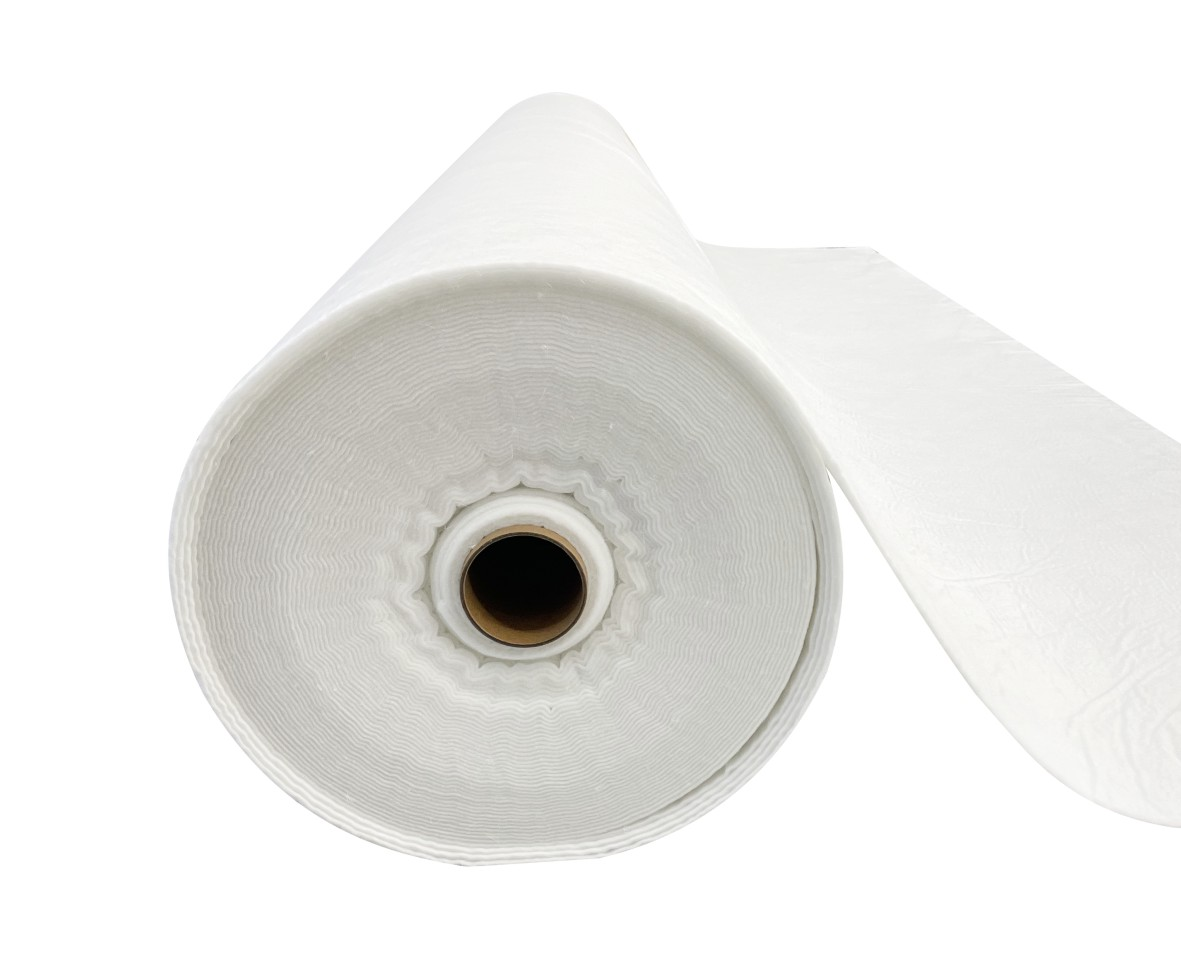
A thicker geotextile can feel more substantial on the roll, but that bulk is not a reliable proxy for strength. In many woven products, high-tenacity polypropylene or polyester yarns are laid in a tight, load-oriented pattern that delivers impressive tensile and tear resistance with relatively little thickness. A heavy needle-punched nonwoven may look twice as thick, yet its fibers are randomly entangled, so it often struggles to match the same grab tensile or trapezoidal tear values.
The manufacturing route shapes this difference. Needle punching builds loft and void space, which helps with drainage and cushioning but does not lock individual filaments into a continuous stress path. By contrast, a thinner heat-bonded or woven geotextile can transfer loads more directly because the fibers or yarns are aligned and bonded under controlled tension. Adding thickness later may simply add weight, cutting difficulties, and cost without improving the engineering numbers that matter on site.
Field selection should therefore start with the required functions—separation, filtration, reinforcement, or protection—and then compare standardized mechanical properties. A 200 g/m² needle-punched nonwoven can be twice as thick as a 200 g/m² woven, but its wide-width tensile strength is often far lower. Over-specifying thickness wastes material and budget, while a leaner product with the right polymer, weave type, and bonding method frequently delivers better long-term performance.
From Polymer Pellets to Ground Reinforcement Fabric
Every roll of ground reinforcement fabric starts life as a stream of unassuming polymer pellets, typically polypropylene or polyester. These tiny granules are fed into an extruder, where heat and pressure transform them into a molten film. The film is then stretched, slit, and drawn into fine, continuous filaments—a process that aligns the molecular chains and gives the material its remarkable tensile strength. What emerges is a flexible yet tough geotextile that can spread loads, separate layers, and stabilize soil under paths, driveways, and construction sites.
The leap from raw pellets to functional fabric hinges on precise control of draw ratios and bonding methods. For woven fabrics, the filaments are interlaced on industrial looms, creating a tight grid that resists deformation. For nonwoven versions, the filaments are laid into a web and then needle-punched or thermally bonded, producing a felt-like structure that excels at filtration and drainage. Each approach tailors the fabric's permeability and puncture resistance, so the same starting pellets can end up as a heavy-duty reinforcement mat or a lightweight separation layer.
Quality checks at this stage are ruthless: tensile tests pull samples until they snap, while permeability trials measure how quickly water passes through. Only rolls that meet strict elongation and tear-strength thresholds get shipped out. The result is a humble-looking black or white fabric that quietly holds gravel in place, keeps subgrades from mixing, and extends the life of pavement—all because someone paid close attention to the journey from pellet to product.
Matching Puncture Resistance to Sharp Aggregate
Selecting a geomembrane for a project involving sharp angular stone often comes down to a simple question: how much abuse can the liner take before it fails? Standard puncture tests provide a baseline, but real-world backfill rarely behaves like a rounded laboratory probe. The jagged edges of crushed rock concentrate stress in ways that a smooth test tip cannot replicate, so a liner that passes a generic puncture value may still tear when dumped against a coarse, unyielding aggregate.
A more reliable approach involves looking beyond the single-number puncture strength and considering the liner's elongation and tear propagation resistance together. Thicker material helps, but thickness alone does not guarantee survival under point loads. Some high-density formulations sacrifice flexibility for stiffness, which can actually make them more prone to localized cracking. Blended polyethylene or specialized elastomeric liners often absorb and redistribute sharp-point stress more effectively, giving them an edge in rocky subgrades where conventional HDPE might struggle.
Field practice matters just as much as the product spec. Using a cushion geotextile above and below the geomembrane reduces direct contact with sharp aggregate, but it should not be treated as a substitute for testing the actual stone-to-liner interface. A quick site-specific puncture trial with the exact backfill material often reveals performance that catalog values miss, saving long-term repair costs from slow leaks that only appear after the overburden settles and grinds against the liner.
What a 20-Year Service Life Actually Requires
A two-decade lifespan doesn't happen by accident. It starts with materials that resist fatigue, corrosion, and UV breakdown long after the warranty expires. Suppliers who cut corners on alloys or sealants won't make it to year ten, let alone twenty. The real test is whether every component—from fasteners to circuit boards—can handle daily thermal cycling, moisture, and vibration without drifting out of spec.
Beyond the bill of materials, you need a maintenance schedule that gets treated as a design input, not an afterthought. Access panels, replaceable wear parts, and clear torque specs all matter more than a slick datasheet. If a bearing can't be swapped in under an hour with standard tools, the product won't stay in service long enough to prove its 20-year claim.
Finally, the manufacturer has to keep supporting the platform. That means revision-controlled documentation, stocked spare parts for discontinued variants, and engineering notes that survive staff turnover. A 20-year service life is less about a single brilliant design and more about the unglamorous discipline of making the same thing work reliably, year after year.
Buying Chinese Geotextiles Without the Quality Gamble
Sourcing geotextiles from China often feels like rolling dice. Many buyers get lured by rock-bottom prices, only to receive rolls that unravel early, clog drainage systems, or fail tensile tests on site. The real gamble isn't the purchase itself—it's assuming all factories operate with the same material standards. To skip the roulette, you need to isolate suppliers who treat polypropylene or polyester as a precise engineering material, not a commodity to be stretched thin for margin.
A practical way to cut risk is to demand batch-level documentation before a single container ships. Ask for third-party test reports that match the exact GSM and strength claims on the quote, not a generic catalog sheet. Check whether the factory uses virgin resin or blends in recycled pellets without disclosure—this single habit explains most hidden performance gaps. Better yet, request a small pilot roll and run your own puncture, elongation, and UV exposure tests under local site conditions. The upfront cost of sampling is trivial compared to replacing failed fabric under a road base or landfill liner.
Finally, move beyond transactional emails. Visit the production line via video walkthrough, confirm the needle-punching density and heat-setting process, and ask how they handle color consistency or edge trimming. Chinese manufacturers who welcome this scrutiny are the ones selling reliability, not just square meters. When you anchor your buying decision to verifiable process control instead of a price tag, the quality gamble disappears.
FAQ
It describes a woven or nonwoven geotextile made in China that separates soil layers, distributes loads, and prevents aggregate from sinking into soft subgrades, which extends the usable life of roads, yards, and foundations.
The fabric acts as a tension membrane. When traffic or structural loads press down, the geotextile stretches slightly and transfers that force horizontally across a wider area, so the soil below does not deform as deeply. It creates a stable platform while keeping the overall profile thin.
Quality products from established Chinese mills use UV-stabilized polypropylene or polyester and have consistent mass per unit area, grab tensile strength, and puncture resistance. When specified correctly, they resist biological degradation, common soil chemicals, and typical UV exposure for years.
You will usually find woven slit-film or monofilament fabrics for high tensile strength, and nonwoven needle-punched fabrics for better drainage and filtration. Some suppliers also offer composite materials that combine a reinforcing scrim with a nonwoven filter layer.
Soft clays, silty soils, marshy edges, and areas with high groundwater respond well. The fabric prevents intermixing of subgrade and imported stone, so you need less fill and avoid rutting or pumping failures in wet seasons.
Yes, most rolls can be laid manually after clearing and grading the surface. Overlap the edges 30 to 60 cm, secure with pins or staples, and place aggregate carefully to avoid shifting the fabric. For very large areas, a spreader bar on a loader speeds things up, but it is not mandatory.
Check the product data sheet for grab tensile strength, elongation at break, CBR puncture resistance, and permittivity. Ask for third-party test reports or certifications like CE marking, and confirm the roll weight, width, and length match what you are paying for. A sample can reveal whether the fibers are uniform and the seams are well bonded.
Chinese manufacturers often offer competitive pricing due to integrated production and bulk raw material sourcing, and many have export experience with reliable lead times. However, freight and import duties must be factored in, and it is wise to order a trial batch before committing to a full container to verify quality consistency.
Conclusion
A well-designed geotextile acts as an invisible load-spreading layer that stops aggregate from punching into soft subgrade, yet its real strength has less to do with thickness than with polymer selection, fiber bonding, and manufacturing consistency. Chinese mills have shifted toward high-tenacity polypropylene and polyester lines that convert resin pellets into needle-punched or woven fabrics with controlled elongation and grab tensile values. In practice, a thinner fabric with dense fiber entanglement can outperform a bulky one that stretches or tears under dynamic loading, so specifiers should look beyond grams per square meter and focus on puncture resistance measured against the sharpness of local stone.
For a service life of two decades, the fabric must resist installation damage, UV exposure during staging, and long-term biological and chemical attack in wet or alkaline soils. That means requesting ISO or ASTM test reports for CBR puncture, trapezoidal tear, and apparent opening size rather than relying on marketing claims. Buying from Chinese suppliers does not have to be a gamble if you verify factory audit results, batch-level quality data, and real project references. The most durable ground reinforcement solutions come from matching the right fabric to the specific aggregate and subgrade, not from chasing the lowest unit price.
Contact Us
Contact Person: Jerry Qiu
Email: [email protected]
Tel/WhatsApp: +65 84265294
Website: https://www.jinseed-geo.com