
MCM Flexible Stone for Interior Walls Manufacturer Offers Premium Lightweight Stone Veneer
2026-08-25
Stone-look interiors don’t have to mean heavy slabs, messy mortar, or limited design options. Magic Stone is redefining the category with MCM flexible stone—a premium lightweight veneer made for interior walls that demand both character and practicality. In this post, we’ll explore what makes this material stand out, where it works best, and why designers are making the switch.
Flexible Stone That Bends to Your Design Vision
Most people think of stone as rigid, heavy, and stubbornly fixed in place. Flexible stone flips that assumption on its head. It arrives as a thin, pliable sheet that can curve around columns, wrap smooth arcs, or follow the gentle sweep of a curved wall without cracking or losing its natural texture.
This isn't a synthetic imitation trying too hard to look real. It's genuine stone — slate, mica, or quartz — bonded to a flexible backing that lets it move with your ideas. You can cut it with a utility knife, bend it by hand, and apply it to surfaces that would normally demand complex fabrication or expensive custom work.
The result is a material that respects the authenticity of stone while giving you the freedom to shape it around your design intent. Whether you're cladding a rounded reception desk, softening a sharp corner, or creating a seamless feature wall, flexible stone bends to fit the space instead of forcing the space to fit the stone.
Bringing Natural Stone Texture Indoors Without the Weight
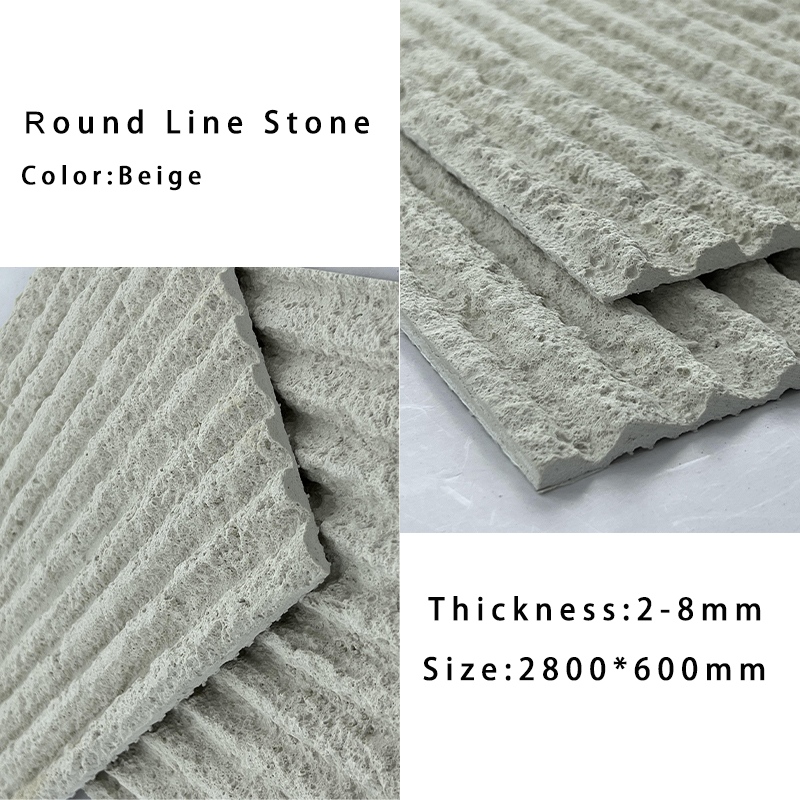
Real stone has a presence that’s hard to fake—until you realize the heaviness, mess, and structural demands are optional. Lightweight alternatives now capture the same rough edges, mineral variation, and cool touch of quarried rock in panels thin enough to hang on drywall. This lets you wrap a fireplace wall or kitchen backsplash in limestone, slate, or ledgestone character without reinforcing framing or wrestling hundred-pound slabs into place.
The trick is in the detailing. Instead of uniform repeats, look for pieces with irregular cleft lines, soft color shifts, and occasional chipped corners. A matte, slightly porous surface reads more like natural stone than a glossy printed finish. Install them tight or with a thin grout line depending on the look—tight joints lean modern and monolithic, while a subtle gap can feel like hand-set masonry.
Even small doses work. A single accent wall, a range hood surround, or a powder room vanity can get that indoor-outdoor mineral feel without a major renovation. Because the material is light, you can use it in places real stone would never go: upper walls, ceilings, or a rental-friendly feature that comes down without damage.
How MCM Panels Transform Ordinary Walls into Focal Points
A plain wall often fades into the background, doing little more than holding up the ceiling. MCM panels change that by introducing depth, texture, and a sense of deliberate design. Instead of a flat, forgettable surface, you get a layered look that catches the eye immediately. The panels can be arranged in patterns or combined with different finishes, making the wall feel like a curated feature rather than an afterthought.
What makes MCM panels especially effective is their ability to play with light and shadow. Even a subtle groove or a slight variation in panel width creates movement across the surface. This dynamic quality draws attention without shouting, giving the room a focal point that feels natural rather than forced. Whether the panels mimic wood grain, brushed metal, or a matte stone texture, they invite people to look closer and touch.
Beyond aesthetics, MCM panels solve a practical problem: how to add character without a major renovation. They install over existing drywall or concrete, so you can transform a dull entryway, accent wall, or reception area in a day. The result is a wall that anchors the space, guiding the eye exactly where you want it to go.
The Craft Behind Lightweight Veneer That Feels Solid
A thin sheet of walnut or oak can easily bend, scratch, and telegraph every flaw in the substrate beneath it. The difference between that fragile layer and a tabletop that feels like a solid slab comes down to how the veneer is cut, glued, and pressed. Skilled shops avoid rotary-cut filler stock and instead use plain-sliced or rift-sawn veneer, keeping grain lines tight enough to mimic the look of dimensional lumber. Leaves are book-matched or slip-matched by hand rather than laid edge to edge by a machine, so the seams nearly vanish under finish.
The core does more work than most people assume. A high-density MDF or Baltic birch substrate gives the veneer a stable, uniform base that resists warping far better than solid wood alone. Cross-banding a secondary veneer on the back face balances moisture movement, while a rigid press—often vacuum or cold-press with cauls—forces adhesive into the wood fibers instead of leaving a thick glue line. That pressure, combined with a slow-curing urea-formaldehyde or PVA adhesive, locks the veneer flat without starving the joint.
What finally sells the illusion is the edge and the finish. A solid wood banding around the perimeter lets the piece be sanded and rounded like a solid board, hiding the core completely. Builders then spray a thin sealer followed by several coats of catalyzed lacquer or hard wax oil, sanding between coats so the surface feels denser than the thin leaf actually is. Under a fingernail or a quick knock, the result registers as solid—even if the total panel weighs half what the same plank would.
Interior Projects Where MCM Stone Shines Brightest
MCM Stone really comes into its own on kitchen islands where a single oversized slab can wrap the counter and waterfall edge without a seam breaking the flow. The material's depth shows up best under a mix of task and pendant lighting, especially when honed rather than polished, so the veining feels more like a woven textile than a hard surface.
Bathroom vanities and shower walls are another sweet spot. A floor-to-ceiling application behind a freestanding tub gives the room a quiet, cave-like calm, and using the same stone for the vanity top and splashback ties the space together without needing extra materials. The stone's resistance to moisture and staining keeps it practical even in a steam-heavy environment.
Feature walls around fireplaces or in entryways also let MCM Stone take center stage. A bookmatched pair of slabs flanking a linear gas fire creates a strong focal point that doesn't compete with furniture, while a low bench or hearth in the same stone extends the visual weight downward. In smaller doses, windowsills and stair treads gain a tailored look that standard porcelain or quartz often lacks.
A Closer Look at Premium Materials Built to Last
Run your hand across the surface and the first thing you notice is the weight—not heavy, but substantial. There's a slight grain to the leather, a tight weave to the nylon, and edges that don't feel sharp or thin. Every material here was physically handled during sampling: bent, rubbed, left out in the rain, and scratched with keys. If a fabric frayed or a buckle showed wear too early, it never made it past the prototype stage.
The hardware gets just as much attention as the fabric. Zippers are solid brass, not coated plastic, so they don't jam or lose teeth after a season of daily use. Stitching uses a heavier thread than standard, with bar tacks at stress points that you can feel if you run a finger along the seams. Even the lining is chosen for how it holds up against friction, not just how it photographs.
Most telling is how these materials age. Instead of cracking or peeling, the leather develops a deeper color where your hands rest. The nylon softens without losing its shape. Scuffs blend in rather than stand out. The idea isn't to keep the product looking brand-new forever—it's to let it wear in, not wear out.
FAQ
MCM stands for modified clay material. It's a lightweight, bendable alternative to conventional stone cladding. Unlike natural stone, it won't crack if the wall shifts slightly, and it's much easier to handle on large interior surfaces.
Yes, that's one of its main strengths. The flexibility lets it wrap around columns, arches, and other non-flat areas without special cutting or extra support.
Absolutely. It's water-resistant and doesn't absorb moisture the way some natural stone products do, so it holds up well in humid environments as long as proper sealing is used at joints.
It's roughly one-fifth to one-eighth the weight of traditional stone. That means you can often install it directly over drywall without adding structural reinforcement.
Very little. A damp cloth and mild detergent are usually enough for routine cleaning. There's no need for periodic sealing or polishing like you'd do with natural stone.
The texture and color variation are designed to mimic real stone closely. From a normal viewing distance, most people can't tell the difference until they touch it, and even then it's only warmer than actual stone.
Yes, it's durable enough for retail, hospitality, and office interiors. The lightweight nature also speeds up installation, which can reduce labor costs on larger projects.
It comes in a range of stone patterns, from slate and travertine to stacked stone looks, and in multiple earth tones and greys. Custom color matching is often available for bulk orders.
Conclusion
MCM flexible stone redefines what interior wall finishes can do. Instead of wrestling with heavy slabs or compromising on texture, designers now have a veneer that bends to curved walls, wraps around columns, and follows the cleanest of lines without cracking. The natural stone surface brings an authentic, tactile richness indoors, yet its lightweight build means existing drywall or furniture panels can handle it without reinforcement. This opens up bold design moves that would otherwise be impossible with traditional stone. A plain hallway becomes a sculpted entry, a living room accent wall gains depth and shadow, and commercial lobbies feel grounded without the structural headaches.
Behind that visual impact is a careful manufacturing process that keeps the veneer feeling solid and substantial despite its featherweight profile. Premium mineral composites and resilient binders are layered to mimic the grain and variation of quarried stone, then backed with a flexible base that holds up to repeated flexing, temperature shifts, and daily wear. It performs exceptionally well in high-traffic interiors like restaurants, boutique hotels, and residential feature walls where both aesthetics and durability matter. Rather than settling for painted drywall or printed laminates, MCM stone gives you a material that looks hand-selected, installs without specialist masonry, and stays true to your design intent for years.
Contact Us
Contact Person: Vito
Email: [email protected]
Tel/WhatsApp: 86 13088879266
Website: https://www.magicstonemcm.com